Return On Investment

In this section we present a quantified analysis of the benefits ORDERLYQ can bring a busy call centre, and provide an estimate of the ROI you can expect to leverage with the OrderlyQ system.

We've produced a second-by-second call centre analysis using actual call centre data to highlight the problems facing a typical Sales line.

Part 1 - Value of Answered Calls

In order to calculate the return on investment generated by answering more calls, we first must value the calls that are already being answered. This is easily done on a Sales line where the value of sales is known.

Calls Answered:
  
Number of Sales:
  
Total Value of Sales:
£ 
Average Value of Sale:
£ per sale
Sale Probability:
  % per call
Value of Answered Calls:
£ per answered call

Over the course of a working day, the sales team makes on average 1098 sales from the 2191 answered calls. The sales for the day totaled £12,928.00, giving an average value per call of £5.91.

Note: If you're entering your own figures and do not know the Number of Sales figure, just leave it as-is. The calculator can work out the Value of Calls without it.

Note: If you're deploying OrderlyQ on a non-sales (e.g. Customer Services) line, then the value of the calls is harder to quantify - but you can use Part 3 of this calculator to find out how much it would cost to hire additional staff to answer the calls, which should give you a good idea of their value.


Part 2 - Cost of Unanswered Calls

Now that we know the value of each answered call, it's easy to calculate the revenue lost for each unanswered call:

Value of Calls:
£ per call
Number of Unanswered Calls:
per day
Working days per week:
Cost of Unanswered Calls:
£ per working day
£ per month
£ per annum

In this example, the team has an abandonment rate of 13%, so the number of Unanswered calls is given by the Number of Answered Calls * 13 / (100 - 13) = 327


Part 3: Cost of Staffing for Peaks

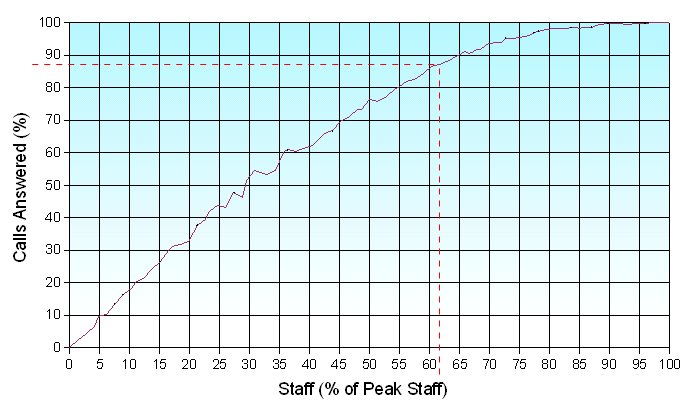
In order to recover the lost revenue from these calls, extra staff will be needed when a standard on-hold queue is used. We've run our analytical second-by-second call centre model with various levels of staff to find out how many calls are answered. The results are shown in the following graph:

The graph flattens at the top, which implies there is a law of diminishing returns on adding extra staff. This is because of the peaks and troughs in call volume, which result in idle time when staff levels are high.

Our sales line is answering 87% of its calls. It has a maximum team size of 45 seats staffed at any one time. Because agents work in shifts, however, there are 72 agents on payroll to man these seats.

Looking at the graph, this means it only has 62% of the staffed agent-seats it would need in order to answer all the incoming calls.

When staffed for peaks, this call centre will need 76 staffed agent-seats in the morning, and 68 staffed agent-seats in the afternoon, or an average of 27 extra manned agent-seats, if it is not to drop any of its calls.

This means the call centre will need an additional 27 * 1.6 = 44 extra agents on payroll to staff the agent-seats required, which is a significant increase in the total size of the call centre.

Furthermore, The overall cost of running a call centre scales with the number of agents, so that agent salaries account for 70% of staff centre costs, on average (Source: DTI). The extra cost of running this sales line with enough agents to handle the calls can therefore be calculated as follows:

Agents on Payroll:
Agents per Seat:
Staffed Agent-Seats:
45
Current Answer Rate:
%
Target Answer Rate:
%
Required Agent-Seats:
Required Agents:
Extra Agents:
Mean Agent Salary:
£ per annum
Salaries / Total Cost:
%
Total Extra Cost:
£ per working day
£ per month
£ per annum

As can be readily seen, this is greater than the value of the dropped calls themselves. Staffing for peaks is therefore simply not a cost-effective strategy.


Solution 2: OrderlyQ

What is needed is a way of answering the dropped calls without the expense of staffing for peaks. In the chart above, we see that there are troughs in activity when some agents are idle. ORDERLYQ works by shifting the peaks in demand into these troughs, resulting in fully utilised agents all day.

We've run the same callers through the same call centre with OrderlyQ managing the queue, informing callers of their wait time, and allowing callers to call back without losing their place.

In our model, callers will hang up immediately when announced a wait time of greater than two minutes. Callers who stay on hold will also hang up on average 45 seconds after their announced wait time expires. Even with such picky callers, the call centre is now able to answer 99.9% of its calls with the same number of staff.

As can be seen, OrderlyQ takes the hit for peaks and troughs in call demand (lilac line), presenting agents with a steady stream of callers (green line) at a rate they can handle. The maximum announced wait time in accross the whole day is only 8 minutes, so callers are still served promptly - but without the hassle of waiting on hold.

The value of OrderlyQ to this call centre is therefore

  • £ 1,253,685 per annum in terms of staff savings, or
  • £ 504,193 per annum in terms of recovered revenue.

Our flexible pricing model has been chosen to ensure that the cost of OrderlyQ is a small fraction of the value of the recovered calls, however large or small your call centre may be. For a full quote, including analysis of your call centre, please contact us for further details, and ask about our free trial.